
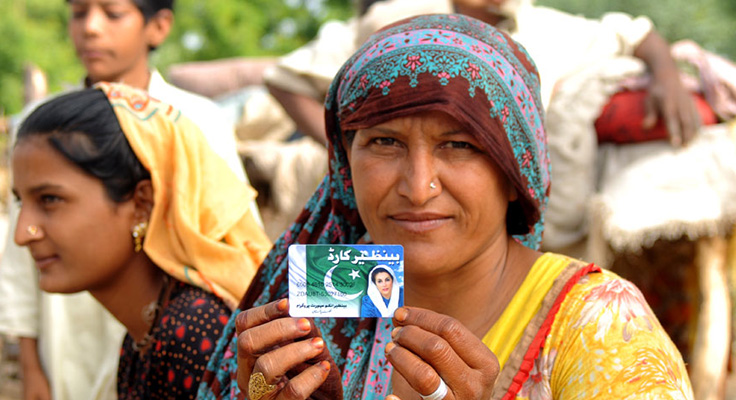
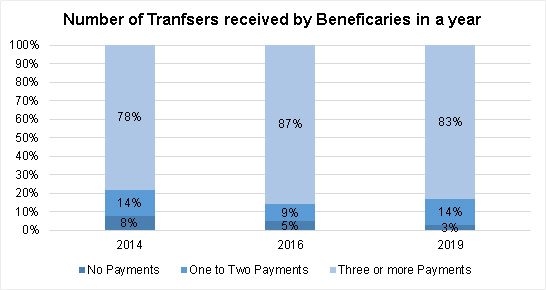
Poverty is considered as one of the highlighted issues in the world which can be curbed through the e-Government model that is identified as a significant tool for alleviating the poverty levels in the developing economies of the world (1). Traditionally, social safety nets (SSNs) are used as a cushion to provide support to citizens facing poverty specifically in developing countries (2). One way to eradicate poverty from its roots is cash transfer a form of SSNs, which is considered as a useful measure to impact the lives of people living at the base of the pyramid (3). Benazir Income Support Programme (BISP), a government to citizens (G2C) service, is one of the largest and most innovative social safety net programmes in South East Asia with total disbursement of PKR 1,080 Billion from year 2008 to 2019 to more than 5 Million families across Pakistan (4). Figure 1. represents a comparison of the number of payments beneficiaries have received in a year from 2014 to 2019.
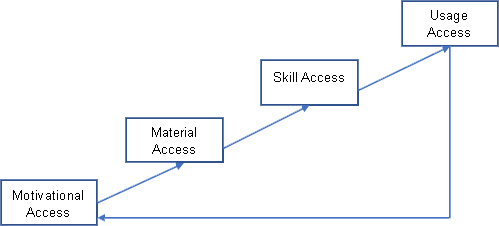
The programme is considered as a scalable example of e-Government initiatives in Pakistan and was initiated in 2008 with the aim to reduce the short-term economic burden of the people. Later, BISP focus shifted to long-term approach with the focus to reduce poverty and establish sustainability (5). The first methodology of disbursement for BISP programme was based on physical cash transfers disbursed through the General Post Office (GPO) of Pakistan. Later when the government’s focus started to shift towards to the e-Government model, it introduced the innovation in BISP by presenting technology-based solutions called digital social payments (DSP) to increase “transparency and reduce any possible pilferage” associated with the payments (3, p. 150). The new technology-based solutions initiated by BISP included BISP debit cards, smart cards, mobile banking, mobile wallets, and bio-metric verification system (BVS) to transfer cash digitally to the beneficiaries (2). Despite the newly implemented initiatives of the government and the efforts to benefit the poor via engagement of technology, the results seem unfruitful. For instance, the BVS is used significantly lower than expected potential which can be achieved when 90% disbursements are distributed by this mechanism. Even though BVS is considered an innovative mechanism for disbursements the actual usage is significantly low (6). The key reason behind the low usage of the new technological solutions is “digital divide” (7, 8) which is defined as “gap between those that have access to vital information technology resources and those that do not have access to those resources” (9, p.1). This qualitative research by deploying Van Dijk’s theory assessed the challenges that hinder the use of technology (7) and act as a barrier in the success of the new technological initiatives. The theory underpins four access issues; motivational, material, skill, and usage access to derive the adaptation of innovation (refer to figure 2).
By using the theory as the theoretical foundation, the study assessed BISP innovation from both the provider and receiver perspective. Below represented are the underlying challenges impacting the digital divide:
The second contribution of the study is that it not only identified the issues pertaining to the digital divide but also explored various strategic options which can be used to narrow this digital gap.
The below table represents a summary of challenges identified in this study along with the potential mitigation solution which can be deployed to reduce the gaps and improving beneficiaries’ access to finance.